
Blog
Blog
How to Automate Property Management System Tasks With AI
How to Automate Property Management System Tasks With AI
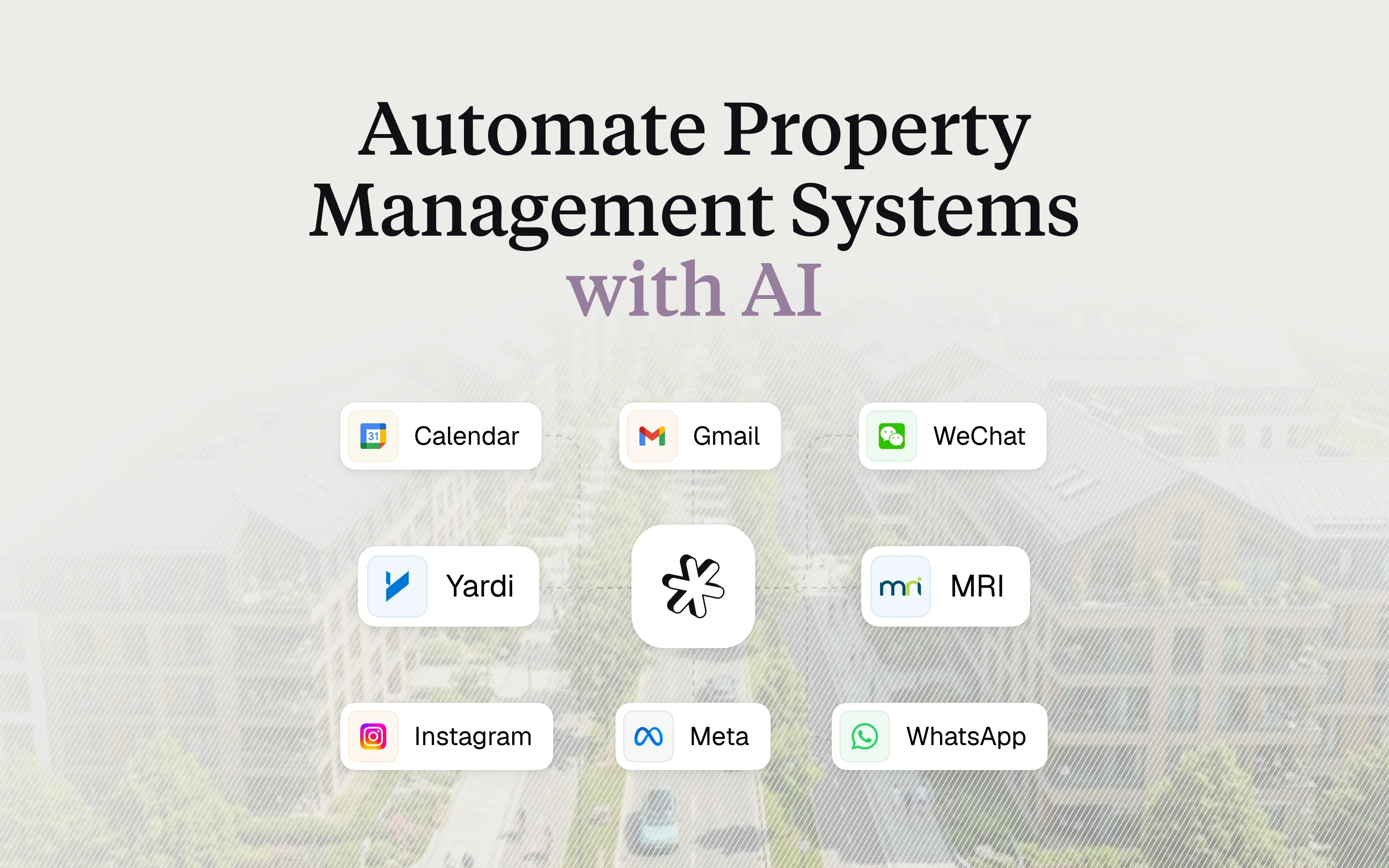
Most property teams already have a property management system. The rent, leases, unit data, contacts, balances, and maintenance history all live there.
However, managing such a robust system for hundreds, even for thousands of tenants can easily overwhelm property operations.
The problem is the repeated work around that system. Someone still replies to enquiries, checks availability, raises tickets, chases documents, follows up arrears, and updates records by hand.
By integrating AI on top of your PMS, you can easily make a smarter system that can handle all the workflows while your teams manage everything else.
In this guide, we will go through how to automate property management systems with AI without replacing the systems you already use.
In Short
To automate a property management system with AI, you put an AI execution layer on top of your existing PMS. The PMS remains the system of record. The AI reads live data from it, runs workflows such as enquiry response, maintenance triage, renewals, arrears, and notices, then writes every action back.
That means the team keeps the system they already trust, while the repetitive work starts moving automatically.
What It Means To Put AI On Top Of Your Current System
Putting AI on top of your current system means the PMS still holds the truth.
Your PMS keeps the rent, lease dates, availability, tenant records, maintenance history, and ledger. It remains the place your team, finance function, and asset managers rely on.
The AI does not replace that. It sits above it and acts on the data.
A simple way to think about it is this:
Layer | What it owns | What the team gets |
|---|---|---|
PMS | Records, rent, leases, balances, availability | A reliable source of truth |
AI layer | Actions, follow ups, routing, updates | Work completed without manual chasing |
Human team | Judgement, exceptions, relationships, approvals | Control where it matters |
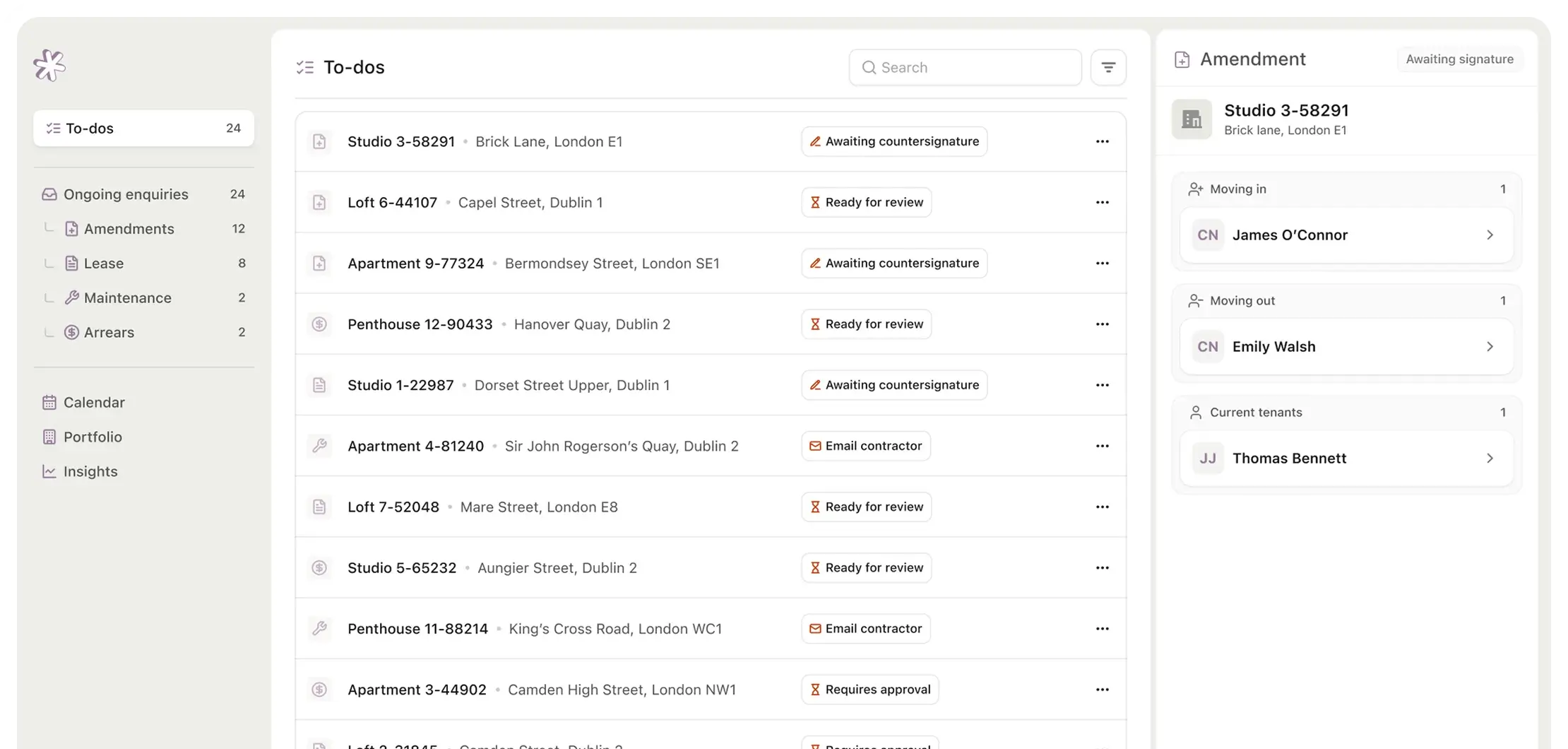
So when a lead asks about a home, the AI checks live availability before it replies. When a resident reports a repair, it checks the property record before it triages the job. When a renewal is due, it follows the workflow and writes the outcome back.
In such a system, nothing gets left out.
This matters for large landlords because most have already spent years building processes around their PMS. A replacement project can take months, disrupt teams, and create risk around data migration. An AI layer avoids that by improving the system you already have.
Lette is built around this model. It acts as an operating layer on top of existing property systems, so the PMS remains the record and the AI runs the repeatable work.
How AI Connects To The System You Already Use
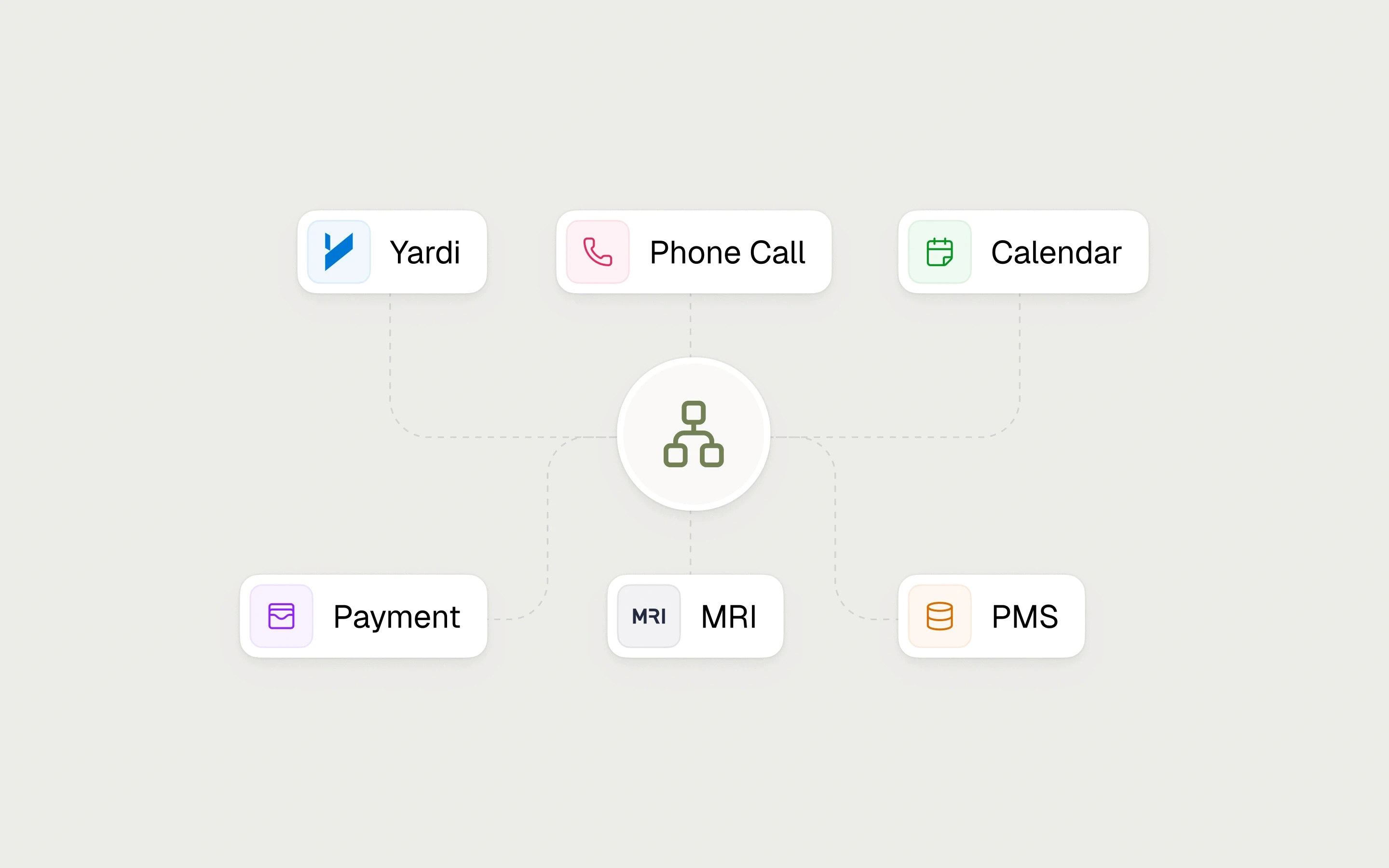
AI connects to property management software in two main ways.
Where the PMS has modern integration options, the AI connects through APIs. Where the system is older and harder to connect, the AI can use secure browser automation to read and write through the screen.
The goal is the same in both cases. Data flows both ways, and nobody has to type the same information twice.
Modern PMS Integration
For systems like Yardi or MRI, the cleanest route is a real time, two way API connection.
The AI can read live data such as:
Unit availability
Rent and pricing
Lease dates
Contact records
Maintenance history
Ledger and balance information
Then it can write back actions such as:
Qualified lead details
Viewing bookings
Maintenance tickets
Work orders
Renewal updates
Arrears notes
Compliance records
This is what makes AI useful inside property management software. It is not just reading a page and suggesting a reply. It is completing the action and updating the source of truth.
For example, a prospect asks about a flat at 8:30pm. The AI checks availability in the PMS, asks move in and affordability questions, offers a real viewing slot, books it, and writes the lead record back into the system.
The next morning, the letting team does not open a cold enquiry. They open a qualified prospect with the viewing already booked.
For deeper integration examples, you can read our articles on Yardi integration and the MRI Software integration.
Legacy System Integration
Not every property management system has a clean modern API.
That is especially true across UK and European residential portfolios, where operators may run older PMS setups, customised databases, or systems that work well enough but do not connect easily.
That should not block automation.
In those cases, AI can still work through secure browser automation. Instead of using an API, it reads and writes through the user interface in the same way a trained operator would. It can open the right screen, read the relevant record, type the update, and move the workflow forward.
The value is practical. You do not need to wait for a full PMS replacement before you automate everyday work.
A modern system can connect through an API. An older system can connect through controlled browser automation. In both cases, the outcome is the same. The PMS stays current, the work gets done, and the team avoids double entry.
Which Everyday Jobs The AI Can Do For You
AI is strongest when the work is high volume, repeatable, and tied to clear rules.
That is exactly what most property operations teams deal with every day.
Workflow | What the AI reads | What the AI does | What it writes back |
|---|---|---|---|
New enquiries | Availability, rent, criteria | Replies, qualifies, books viewings | Lead record and booking |
Repairs | Resident record, property details, history | Triages, asks questions, routes the job | Ticket and work order |
Renewals | Lease dates and current terms | Starts reminders and chases signature | Renewal status |
Arrears | Ledger and payment status | Sends scheduled follow ups | Contact history and notes |
Notices | Tenancy details and approved templates | Sends the right notice at the right time | Timestamped record |
Reporting | Live workflow data | Surfaces performance and bottlenecks | Portfolio level insight |
The important part is the round trip.
The AI reads what it needs. It does the task. It writes the result back.
That removes the grey area where work happens in email, WhatsApp, spreadsheets, or someone’s notes, but the PMS never gets updated properly.
Example: Late Evening Repair
A resident messages at 9:15pm about water coming from under the sink.
In the old model, the message waits until someone is back at their desk. The resident is anxious. The team starts the morning already behind.
With AI on top of the PMS, the workflow starts immediately.
The AI checks the resident and property record. It asks for a photo. It asks whether the water is still running. It checks whether the repair looks urgent. It gives safe first steps, such as turning off the local valve if appropriate. If a contractor is needed, it creates the ticket, routes it to the approved trade, and writes the work order back into the PMS.
By the time the team comes in, the job has already been triaged and logged.
The property manager still owns anything sensitive or unusual. The AI simply removes the delay from the routine part.
That is the difference between a chatbot and true AI property management. A chatbot replies. An AI operating layer moves the job forward.
What AI Saves In Money And Staff Time
The first saving is time. Every manual step around the PMS takes longer than people think. A team member reads a message, checks the PMS, replies, opens another system, books a slot, copies a note, updates a record, and then moves to the next task.
One task is small. Thousands of tasks across a portfolio are not. AI removes the repeated steps and automates processes.
That gives teams time back for the work that needs a person: complex repairs, resident relationships, negotiations, complaints, asset decisions, building issues, and onsite judgement, among other tasks.
The second saving is void time. If a home is empty, every day without rent is lost income. The fastest way to reduce voids is not always a bigger marketing budget. Often it is faster response, faster qualification, and fewer dropped leads.
AI helps by responding when the enquiry arrives, not when the team next opens the inbox.
That is why automate pms projects become financial projects, not just operational projects. They reduce the lag between interest and action.
The third saving is headcount pressure. Manual operations usually scale in a straight line. More homes create more enquiries, more repairs, more renewals, more arrears, and more admin.
Automation bends that line.
One early Lette customer added 1,000 more homes without hiring another property manager. The reason was not that the team worked harder. It was that more of the repeatable work moved through the system automatically.
The broader market logic is similar. McKinsey estimates that generative AI could create $110 Billion or more in value for real estate, especially where companies redesign workflows around AI rather than only adding a tool on the side.
For institutional operators, the lesson is simple. The value does not come from AI existing. It comes from AI doing work inside the operating model.
Is It Safe To Let AI Work Inside Your PMS
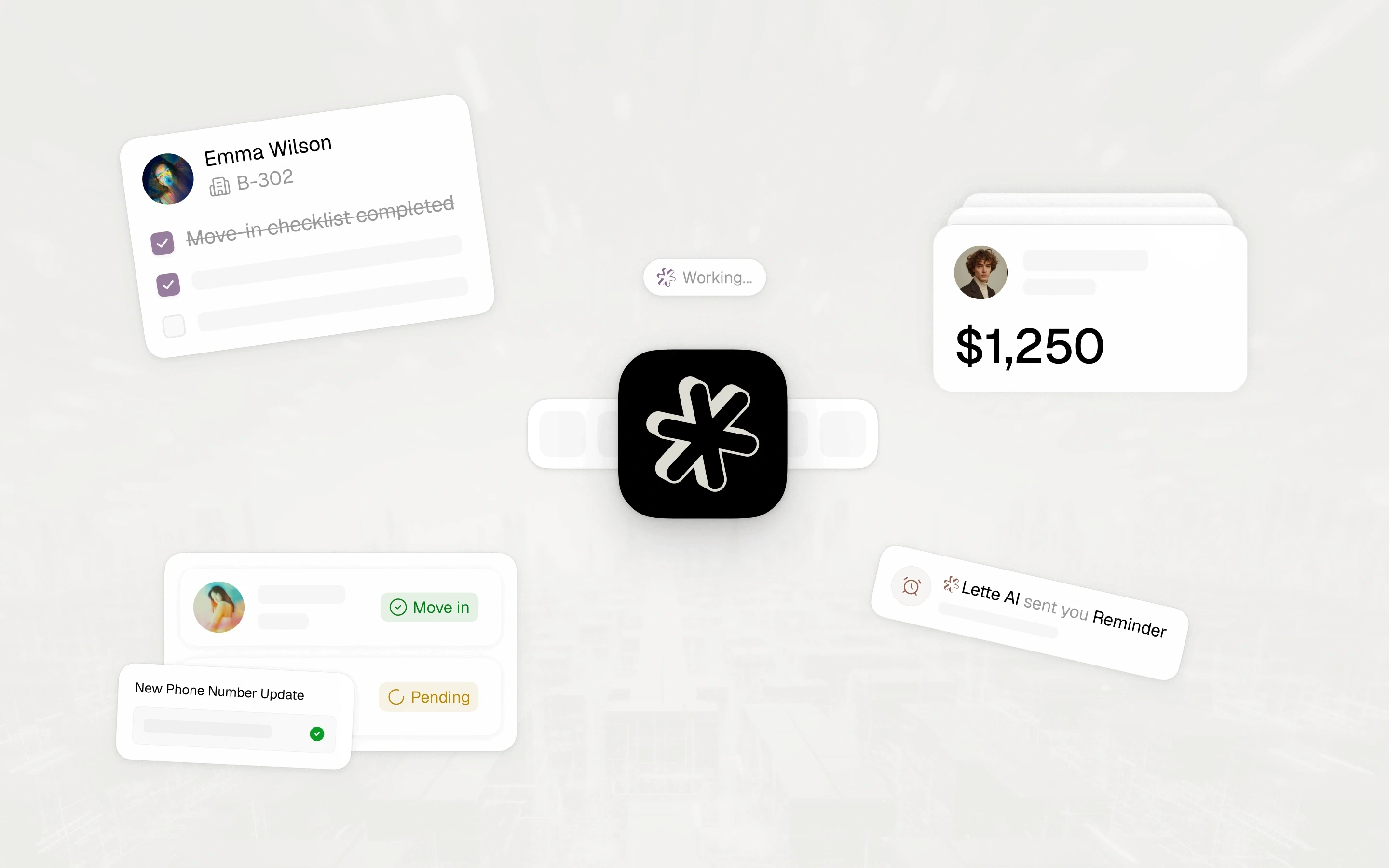
Yes, if the AI is designed with clear limits, live data, audit trails, and human escalation.
The safest model is not an AI that tries to decide everything. It is an AI that knows what it can do, knows when to stop, and brings in a person when the work needs judgement.
It works from live records
An AI layer should work from live PMS data, not a stale copy.
That matters because property operations change quickly. A unit may be available at 10am and reserved at 11am. A repair may be open in the morning and completed by the afternoon. A balance may change after a payment lands.
If the AI is connected to the live record, it can answer and act from current information.
That is how the system avoids promising the wrong home, quoting the wrong rent, or missing a recent update. It checks the source of truth first.
It escalates when the work needs a person
Routine work should move automatically. Sensitive work should not.
A repair triage question can be automated. A vulnerable resident in distress needs a person. A missing document reminder can be automated. A disputed applicant decision needs review. A standard notice can follow an approved workflow. A complaint about fairness needs human judgement.
A well designed AI system should recognise that boundary.
When it is unsure, it should pause, summarise the context, and hand the case to the right person. The team should see the conversation history, the record, and what has already happened.
That keeps humans in control without forcing them to handle every routine step.
For property teams, the practical takeaway is not to avoid AI. It is to choose AI that is constrained, logged, and reviewable.
It keeps data in the right place
For UK and European landlords, data location and security are part of the buying decision.
Resident and applicant data is sensitive. It can include names, phone numbers, emails, tenancy information, payment status, maintenance history, and sometimes documents.
A serious AI property management system should be clear about:
Where the data is hosted
Who can access it
Whether data is encrypted
Whether customer data is used for model training
How actions are logged
How humans review escalations
The point is not to bury the buyer in certifications. It is to give clear answers before procurement has to ask.
What To Check Before You Automate Your PMS
When trying to find a reliable AI to automate your property management operations, ask some practical questions:
Question | Why it matters |
|---|---|
Does it sit on top of our PMS | Avoids a replacement project |
Does it read and write back | Removes double entry |
Does it use live records | Prevents stale answers |
Does it work with old systems | Avoids waiting for a new PMS |
Does it automate real workflows | Separates action from chat |
Does it escalate uncertainty | Keeps people in control |
Does it log every action | Creates a usable audit trail |
Where is the data hosted | Supports security and due diligence |
The strongest buying question is: Does the AI actually do the work, or does it just create another place for the team to check?
If the answer is another inbox, another dashboard, or another manual handoff, the team may not save much time. If the answer is read, act, and write back, the operating model changes.
Common Questions People Ask
Does AI replace the property management system we already use?
No. The AI sits on top of the property management system. The PMS stays the system of record for leases, rent, balances, availability, and resident data. The AI adds an action layer that runs workflows and writes the outcome back.
What happens if our current system is old and hard to connect?
A modern PMS can connect through an API. An older system can often connect through secure browser automation, where the AI reads and writes through the screen in a controlled way. That lets teams automate PMS workflows without waiting for a replacement project.
Can AI make up a price or offer a home that is not available?
A well designed AI layer should only answer from live PMS data and approved rules. If the unit is not available in the PMS, the AI should not offer it. If pricing is unclear or missing, it should escalate instead of guessing.
What does the AI do when it is not sure?
It should stop, summarise the issue, and hand the case to a person with the context attached. That is the right model for property operations. Routine work keeps moving, while judgement stays with the team.
Where is the information kept?
For UK and European operators, the provider should clearly explain where data is hosted, who can access it, what is encrypted, how records are logged, and whether customer data is used to train external models. These answers should be available before security review.
Is this just a chatbot?
No. A chatbot answers messages. An AI layer on top of a PMS completes workflows. It can qualify a lead, book a viewing, triage a repair, chase a payment, serve a notice, and update the record. The test is whether the work is done inside the system, not whether a message was answered.
What’s Next?
Most property teams do not need another system to check. They need the systems they already have to do more of the work.
That is what happens when AI sits on top of the PMS. The records stay where they are. The team keeps the software they know. The repeat work starts moving automatically.
The practical next step is to watch one real workflow run from start to finish. A lead comes in, a repair is reported, or a renewal starts. The AI reads the PMS, completes the task, and writes the result back.
If you want to see what that looks like across your own stack, book a friendly chat with Lette and we’ll walk you through a real example.
Most property teams already have a property management system. The rent, leases, unit data, contacts, balances, and maintenance history all live there.
However, managing such a robust system for hundreds, even for thousands of tenants can easily overwhelm property operations.
The problem is the repeated work around that system. Someone still replies to enquiries, checks availability, raises tickets, chases documents, follows up arrears, and updates records by hand.
By integrating AI on top of your PMS, you can easily make a smarter system that can handle all the workflows while your teams manage everything else.
In this guide, we will go through how to automate property management systems with AI without replacing the systems you already use.
In Short
To automate a property management system with AI, you put an AI execution layer on top of your existing PMS. The PMS remains the system of record. The AI reads live data from it, runs workflows such as enquiry response, maintenance triage, renewals, arrears, and notices, then writes every action back.
That means the team keeps the system they already trust, while the repetitive work starts moving automatically.
What It Means To Put AI On Top Of Your Current System
Putting AI on top of your current system means the PMS still holds the truth.
Your PMS keeps the rent, lease dates, availability, tenant records, maintenance history, and ledger. It remains the place your team, finance function, and asset managers rely on.
The AI does not replace that. It sits above it and acts on the data.
A simple way to think about it is this:
Layer | What it owns | What the team gets |
|---|---|---|
PMS | Records, rent, leases, balances, availability | A reliable source of truth |
AI layer | Actions, follow ups, routing, updates | Work completed without manual chasing |
Human team | Judgement, exceptions, relationships, approvals | Control where it matters |
So when a lead asks about a home, the AI checks live availability before it replies. When a resident reports a repair, it checks the property record before it triages the job. When a renewal is due, it follows the workflow and writes the outcome back.
In such a system, nothing gets left out.
This matters for large landlords because most have already spent years building processes around their PMS. A replacement project can take months, disrupt teams, and create risk around data migration. An AI layer avoids that by improving the system you already have.
Lette is built around this model. It acts as an operating layer on top of existing property systems, so the PMS remains the record and the AI runs the repeatable work.
How AI Connects To The System You Already Use
AI connects to property management software in two main ways.
Where the PMS has modern integration options, the AI connects through APIs. Where the system is older and harder to connect, the AI can use secure browser automation to read and write through the screen.
The goal is the same in both cases. Data flows both ways, and nobody has to type the same information twice.
Modern PMS Integration
For systems like Yardi or MRI, the cleanest route is a real time, two way API connection.
The AI can read live data such as:
Unit availability
Rent and pricing
Lease dates
Contact records
Maintenance history
Ledger and balance information
Then it can write back actions such as:
Qualified lead details
Viewing bookings
Maintenance tickets
Work orders
Renewal updates
Arrears notes
Compliance records
This is what makes AI useful inside property management software. It is not just reading a page and suggesting a reply. It is completing the action and updating the source of truth.
For example, a prospect asks about a flat at 8:30pm. The AI checks availability in the PMS, asks move in and affordability questions, offers a real viewing slot, books it, and writes the lead record back into the system.
The next morning, the letting team does not open a cold enquiry. They open a qualified prospect with the viewing already booked.
For deeper integration examples, you can read our articles on Yardi integration and the MRI Software integration.
Legacy System Integration
Not every property management system has a clean modern API.
That is especially true across UK and European residential portfolios, where operators may run older PMS setups, customised databases, or systems that work well enough but do not connect easily.
That should not block automation.
In those cases, AI can still work through secure browser automation. Instead of using an API, it reads and writes through the user interface in the same way a trained operator would. It can open the right screen, read the relevant record, type the update, and move the workflow forward.
The value is practical. You do not need to wait for a full PMS replacement before you automate everyday work.
A modern system can connect through an API. An older system can connect through controlled browser automation. In both cases, the outcome is the same. The PMS stays current, the work gets done, and the team avoids double entry.
Which Everyday Jobs The AI Can Do For You
AI is strongest when the work is high volume, repeatable, and tied to clear rules.
That is exactly what most property operations teams deal with every day.
Workflow | What the AI reads | What the AI does | What it writes back |
|---|---|---|---|
New enquiries | Availability, rent, criteria | Replies, qualifies, books viewings | Lead record and booking |
Repairs | Resident record, property details, history | Triages, asks questions, routes the job | Ticket and work order |
Renewals | Lease dates and current terms | Starts reminders and chases signature | Renewal status |
Arrears | Ledger and payment status | Sends scheduled follow ups | Contact history and notes |
Notices | Tenancy details and approved templates | Sends the right notice at the right time | Timestamped record |
Reporting | Live workflow data | Surfaces performance and bottlenecks | Portfolio level insight |
The important part is the round trip.
The AI reads what it needs. It does the task. It writes the result back.
That removes the grey area where work happens in email, WhatsApp, spreadsheets, or someone’s notes, but the PMS never gets updated properly.
Example: Late Evening Repair
A resident messages at 9:15pm about water coming from under the sink.
In the old model, the message waits until someone is back at their desk. The resident is anxious. The team starts the morning already behind.
With AI on top of the PMS, the workflow starts immediately.
The AI checks the resident and property record. It asks for a photo. It asks whether the water is still running. It checks whether the repair looks urgent. It gives safe first steps, such as turning off the local valve if appropriate. If a contractor is needed, it creates the ticket, routes it to the approved trade, and writes the work order back into the PMS.
By the time the team comes in, the job has already been triaged and logged.
The property manager still owns anything sensitive or unusual. The AI simply removes the delay from the routine part.
That is the difference between a chatbot and true AI property management. A chatbot replies. An AI operating layer moves the job forward.
What AI Saves In Money And Staff Time
The first saving is time. Every manual step around the PMS takes longer than people think. A team member reads a message, checks the PMS, replies, opens another system, books a slot, copies a note, updates a record, and then moves to the next task.
One task is small. Thousands of tasks across a portfolio are not. AI removes the repeated steps and automates processes.
That gives teams time back for the work that needs a person: complex repairs, resident relationships, negotiations, complaints, asset decisions, building issues, and onsite judgement, among other tasks.
The second saving is void time. If a home is empty, every day without rent is lost income. The fastest way to reduce voids is not always a bigger marketing budget. Often it is faster response, faster qualification, and fewer dropped leads.
AI helps by responding when the enquiry arrives, not when the team next opens the inbox.
That is why automate pms projects become financial projects, not just operational projects. They reduce the lag between interest and action.
The third saving is headcount pressure. Manual operations usually scale in a straight line. More homes create more enquiries, more repairs, more renewals, more arrears, and more admin.
Automation bends that line.
One early Lette customer added 1,000 more homes without hiring another property manager. The reason was not that the team worked harder. It was that more of the repeatable work moved through the system automatically.
The broader market logic is similar. McKinsey estimates that generative AI could create $110 Billion or more in value for real estate, especially where companies redesign workflows around AI rather than only adding a tool on the side.
For institutional operators, the lesson is simple. The value does not come from AI existing. It comes from AI doing work inside the operating model.
Is It Safe To Let AI Work Inside Your PMS
Yes, if the AI is designed with clear limits, live data, audit trails, and human escalation.
The safest model is not an AI that tries to decide everything. It is an AI that knows what it can do, knows when to stop, and brings in a person when the work needs judgement.
It works from live records
An AI layer should work from live PMS data, not a stale copy.
That matters because property operations change quickly. A unit may be available at 10am and reserved at 11am. A repair may be open in the morning and completed by the afternoon. A balance may change after a payment lands.
If the AI is connected to the live record, it can answer and act from current information.
That is how the system avoids promising the wrong home, quoting the wrong rent, or missing a recent update. It checks the source of truth first.
It escalates when the work needs a person
Routine work should move automatically. Sensitive work should not.
A repair triage question can be automated. A vulnerable resident in distress needs a person. A missing document reminder can be automated. A disputed applicant decision needs review. A standard notice can follow an approved workflow. A complaint about fairness needs human judgement.
A well designed AI system should recognise that boundary.
When it is unsure, it should pause, summarise the context, and hand the case to the right person. The team should see the conversation history, the record, and what has already happened.
That keeps humans in control without forcing them to handle every routine step.
For property teams, the practical takeaway is not to avoid AI. It is to choose AI that is constrained, logged, and reviewable.
It keeps data in the right place
For UK and European landlords, data location and security are part of the buying decision.
Resident and applicant data is sensitive. It can include names, phone numbers, emails, tenancy information, payment status, maintenance history, and sometimes documents.
A serious AI property management system should be clear about:
Where the data is hosted
Who can access it
Whether data is encrypted
Whether customer data is used for model training
How actions are logged
How humans review escalations
The point is not to bury the buyer in certifications. It is to give clear answers before procurement has to ask.
What To Check Before You Automate Your PMS
When trying to find a reliable AI to automate your property management operations, ask some practical questions:
Question | Why it matters |
|---|---|
Does it sit on top of our PMS | Avoids a replacement project |
Does it read and write back | Removes double entry |
Does it use live records | Prevents stale answers |
Does it work with old systems | Avoids waiting for a new PMS |
Does it automate real workflows | Separates action from chat |
Does it escalate uncertainty | Keeps people in control |
Does it log every action | Creates a usable audit trail |
Where is the data hosted | Supports security and due diligence |
The strongest buying question is: Does the AI actually do the work, or does it just create another place for the team to check?
If the answer is another inbox, another dashboard, or another manual handoff, the team may not save much time. If the answer is read, act, and write back, the operating model changes.
Common Questions People Ask
Does AI replace the property management system we already use?
No. The AI sits on top of the property management system. The PMS stays the system of record for leases, rent, balances, availability, and resident data. The AI adds an action layer that runs workflows and writes the outcome back.
What happens if our current system is old and hard to connect?
A modern PMS can connect through an API. An older system can often connect through secure browser automation, where the AI reads and writes through the screen in a controlled way. That lets teams automate PMS workflows without waiting for a replacement project.
Can AI make up a price or offer a home that is not available?
A well designed AI layer should only answer from live PMS data and approved rules. If the unit is not available in the PMS, the AI should not offer it. If pricing is unclear or missing, it should escalate instead of guessing.
What does the AI do when it is not sure?
It should stop, summarise the issue, and hand the case to a person with the context attached. That is the right model for property operations. Routine work keeps moving, while judgement stays with the team.
Where is the information kept?
For UK and European operators, the provider should clearly explain where data is hosted, who can access it, what is encrypted, how records are logged, and whether customer data is used to train external models. These answers should be available before security review.
Is this just a chatbot?
No. A chatbot answers messages. An AI layer on top of a PMS completes workflows. It can qualify a lead, book a viewing, triage a repair, chase a payment, serve a notice, and update the record. The test is whether the work is done inside the system, not whether a message was answered.
What’s Next?
Most property teams do not need another system to check. They need the systems they already have to do more of the work.
That is what happens when AI sits on top of the PMS. The records stay where they are. The team keeps the software they know. The repeat work starts moving automatically.
The practical next step is to watch one real workflow run from start to finish. A lead comes in, a repair is reported, or a renewal starts. The AI reads the PMS, completes the task, and writes the result back.
If you want to see what that looks like across your own stack, book a friendly chat with Lette and we’ll walk you through a real example.

Ready to simplify your property operations?
See how Lette helps leasing and residential teams automate daily work, respond faster, and scale with confidence.

167-169 Great Portland Street 5th Floor London W1W 5PF
33 Fitzwilliam Place, Dublin 2 Carroll Estates Mews DUBLIN 2 D02 A5W0 IRELAND
info@lette.ai

Ready to simplify your property operations?
See how Lette helps leasing and residential teams automate daily work, respond faster, and scale with confidence.
167-169 Great Portland Street 5th Floor London W1W 5PF
33 Fitzwilliam Place, Dublin 2 Carroll Estates Mews DUBLIN 2 D02 A5W0 IRELAND
info@lette.ai
Ready to simplify your property operations?
See how Lette helps leasing and residential teams automate daily work, respond faster, and scale with confidence.
167-169 Great Portland Street 5th Floor London W1W 5PF
33 Fitzwilliam Place, Dublin 2 Carroll Estates Mews DUBLIN 2 D02 A5W0 IRELAND
info@lette.ai
Ready to simplify your property operations?
See how Lette helps leasing and residential teams automate daily work, respond faster, and scale with confidence.
167-169 Great Portland Street 5th Floor London W1W 5PF
33 Fitzwilliam Place, Dublin 2 Carroll Estates Mews DUBLIN 2 D02 A5W0 IRELAND
info@lette.ai