
Blog
Blog
How to Calculate AI ROI in Property Management
How to Calculate AI ROI in Property Management

If you are putting AI on top of your PMS to move faster, handle more work and scale your portfolio, one question matters: is the AI creating measurable value?
To calculate AI ROI in property management, compare the measurable benefit from one AI-enabled workflow with the full cost of launching and running it. Keep cash return, forecast savings, released team capacity and service improvements separate so you can see what is financially realised and what is operationally valuable.
We see the same goal across ambitious property teams: grow the portfolio without growing admin at the same pace.
That is why we built Lette, the Property Management & Leasing Automation Platform that sits on top of your existing PMS and property stack. Your PMS remains the system of record.
We automate the repetitive work around it across leasing, resident operations, maintenance, and reporting so your team can move faster and scale without replacing the systems you already trust.
This guide shows you how to measure AI ROI in property management without turning it into a Finance-only exercise.
You will learn how to build a baseline, calculate costs and benefits, use an AI ROI calculator, measure property management automation ROI, estimate the AI payback period, and understand property management technology total cost of ownership. Finance verifies realised financial value, but the evidence starts with the teams doing the work: operations, asset management, leasing, resident operations and maintenance.
AI ROI in Property Management
AI ROI in property management is the return you create when an AI-enabled workflow improves how your team runs the operation. That return may come from lower cost, protected income, avoided future cost or the ability to handle more work with the same team.
Measure it at workflow level, such as leasing, resident operations, maintenance or reporting, rather than confusing it with the investment return from owning the properties themselves.
Not every valuable improvement becomes cash on day one.
You may clear queues faster, handle more resident conversations, keep your PMS cleaner or add units without adding headcount at the same rate. Those gains belong in the AI ROI in property management case.
They should enter headline financial ROI only when there is a clear financial mechanism that Finance can verify.
Measure | What it asks | Keep it separate from |
|---|---|---|
AI ROI | Did the workflow return more cash than it cost | Property return |
NOI | Did property income less operating cost change | Technology ROI |
Asset value | How might future income affect value | The same underlying cash gain |
Released capacity | What work can the team now do | Payroll saving unless a cost action occurs |
ROI, NOI, and Asset Value
AI can affect NOI when it creates a genuine operating change, such as lower expenditure or rent protected by avoiding part of a void period. That does not make AI ROI, NOI and asset value the same measure.
Count the underlying cash gain once in the AI ROI calculation. You may then show how that gain affects NOI, but treat it as a link to the same benefit rather than another benefit line. Any asset value sensitivity should also remain separate.
Whose Return Are You Calculating?
Before you add a single figure, decide who is paying for the technology, who receives the benefit and who owns the workflow. This keeps AI ROI in property management useful to the teams running the operation as well as the people approving the investment.
The same workflow can create different returns for an owner, an operating company and a third-party manager.
For example, your operating company may pay for the platform and reduce temporary staffing costs. The owner may benefit from rent protected through a shorter void. A management company may lower its cost to serve or improve contract margin. Calculate the return around the costs and benefits that actually sit with the entity making the decision.
Owner Operators and Third Party Managers
Owner operators can review rent, property operating expenses and the cost of their own operating company. Third-party managers should focus on contract margin, service levels, cost to serve and the cost of winning or onboarding new instructions.
Do not include an owner benefit in the manager's ROI unless the management contract passes that benefit to the manager.
How Should Shared Costs and Benefits Be Allocated?
Assign every shared cost and benefit to one owner before combining the figures. Use an allocation driver that is simple, consistent and easy to test. Suitable drivers may include active units, workflow volume, legal entity or share of service time.
Keep the chosen driver unchanged throughout the reporting period.
Shared item | Possible driver | Named owner |
|---|---|---|
Platform cost | Active units | Operating company |
Integration cost | Workflow volume | Workflow owner |
Rent protection | Asset and legal entity | Owner entity |
Service cost saving | Cases handled | Management company |
Three AI ROI Views Property Teams Should Keep Separate
Keep three views side by side. Strict realised ROI shows cash or accrual value that Finance can verify. Inclusive forecast ROI adds approved future savings. The operational capacity view shows the time, service, throughput and scaling gains your team is getting back without pretending they are already cash. This is what makes AI ROI in property management useful for operating decisions, not just budget reviews.
The most useful figure is not always the largest one. It is the figure that answers the decision being made and clearly shows the evidence behind it.
Outcome | Strict realised ROI | Inclusive forecast ROI | Capacity scorecard |
|---|---|---|---|
Payroll reduction | Yes when booked | Yes when approved and timed | Show team effect |
Cancelled supplier cost | Yes when spend changes | Yes if contract exit is agreed | Show service effect |
Avoided hire | No until cost action | Yes with approved plan | Show added workload |
Hours returned | No | No | Yes |
Resident service gain | No | No unless cash link is known | Yes |
Strict Realised Financial ROI
For a property management AI ROI model, this is the most conservative view. Use it when you need to show leadership what value has already moved from faster work or better operations into a verifiable cost or income line.
Strict realised ROI includes only attributable benefits that Finance can verify against the full incremental cost of the workflow. Examples include a removed external cost, a booked payroll reduction or verified rent protection.
Use one reporting period, one currency, one entity boundary and one accounting basis throughout the calculation.
When Can Forecast Cost Avoidance Be Included?
Include an avoided hire or planned supplier reduction only in the inclusive forecast view. Record the approved role or contract, loaded cost, expected start date, budget owner and the reason the AI workflow makes the saving possible.
Move the benefit into strict realised ROI only after the staffing or supplier cost has actually changed.
Which Benefits Should Stay Outside Headline ROI?
Keep released capacity, faster service, resident experience and risk reduction in a supporting scorecard until there is a documented cash link.
These outcomes may be central to the value of the workflow. They do not become cash simply because someone multiplies saved hours by an hourly salary rate.
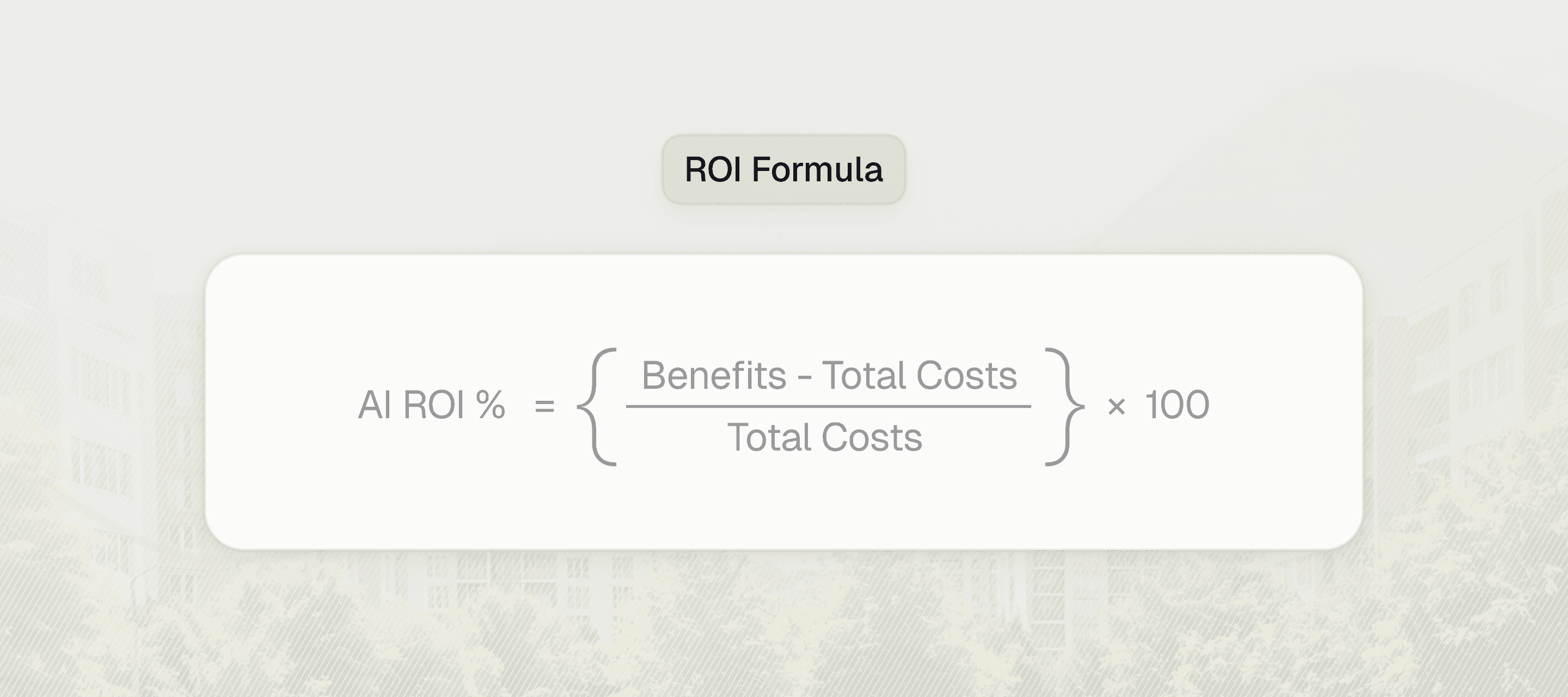
The AI ROI Formula
Use one strict formula for the headline result. Define the workflow, entity, period, currency and accounting basis first. Then compare verified attributable benefits with the total incremental cost inside that same boundary.
An ROI calculator can handle the arithmetic. The real work is making sure the inputs reflect what actually changed in your operation.
Do not combine forecast, observed and realised values in one ROI percentage.
Strict AI ROI percentage equals finance-verified attributable benefits minus total incremental costs, divided by total incremental costs, multiplied by 100.
Input | Plain meaning |
|---|---|
Attributable benefits | Cash or accrual gain Finance can trace to the workflow |
Total incremental costs | All new cost to put and keep the workflow live |
Net benefit | Attributable benefits less total incremental costs |
ROI percentage | Net benefit divided by total incremental costs, multiplied by 100 |
The Strict ROI Formula
An AI ROI calculator should use the same boundary for costs and benefits. Do not enter portfolio-wide benefits against the cost of a single workflow or mix annualised estimates with realised values.
For a finance-verified headline calculation, use:
Strict AI ROI percentage equals finance-verified attributable benefits less total incremental costs, divided by total incremental costs, multiplied by 100.
For example, if verified benefits are £90,000 and total incremental costs are £60,000, the net benefit is £30,000. Strict ROI is therefore 50 per cent.
The calculation is straightforward. The quality of the result depends on the evidence supporting the £90,000 benefit.
How Should Forecast, Observed, and Realised Results Be Labelled?
Label every result according to its evidence status. A forecast is an assumption. An approved forecast has a named budget action behind it. An observed result is what the pilot produced. A finance-verified result has been checked by Finance. A realised result has reached the accounts. An annualised pilot run rate should not be presented as a realised portfolio result.
What Baseline Data Do Property Teams Need for a Defensible AI ROI?
Start with the smallest useful unit: one workflow, asset group or legal entity. Before AI changes the process, record the current workload, delay, cost and outcome. If you are using AI on top of your PMS, this baseline is what turns AI ROI in property management from a vague productivity claim into a measurable operating result.
A clean baseline makes it easier to show what changed, what stayed the same and which result can reasonably be attributed to the workflow.
We cover detailed event definitions and reporting practice in our property management data and KPI guide.
Which Inputs Should Come From Operations, Finance, and the PMS?
Your operations teams should own workflow volume, case status and service steps. Your PMS should remain the system of record for source events and core case data. Finance, payroll and contract records should support labour costs, supplier spend and realised cash outcomes.
Put the source of truth next to every number. If the figure cannot be traced, do not build a scaling decision around it.
Input | Source of truth | Owner |
|---|---|---|
Lead or repair volume | PMS and workflow log | Operations |
Case state and delay | PMS | Workflow owner |
Payroll cost | Payroll and Finance | Finance |
Supplier spend | Contract and invoice | Finance |
Rent protected | PMS and Finance record | Owner entity |
Seasonality and Portfolio Mix
Compare similar assets, unit types, markets and demand periods wherever possible. Do not annualise a strong lease-up month, a short launch period or one unusual site without adjusting for the conditions that made it different.
Record the limits of the comparison so the next reviewer can see where the result may be less reliable.
Which Costs Belong in AI Total Cost of Ownership?
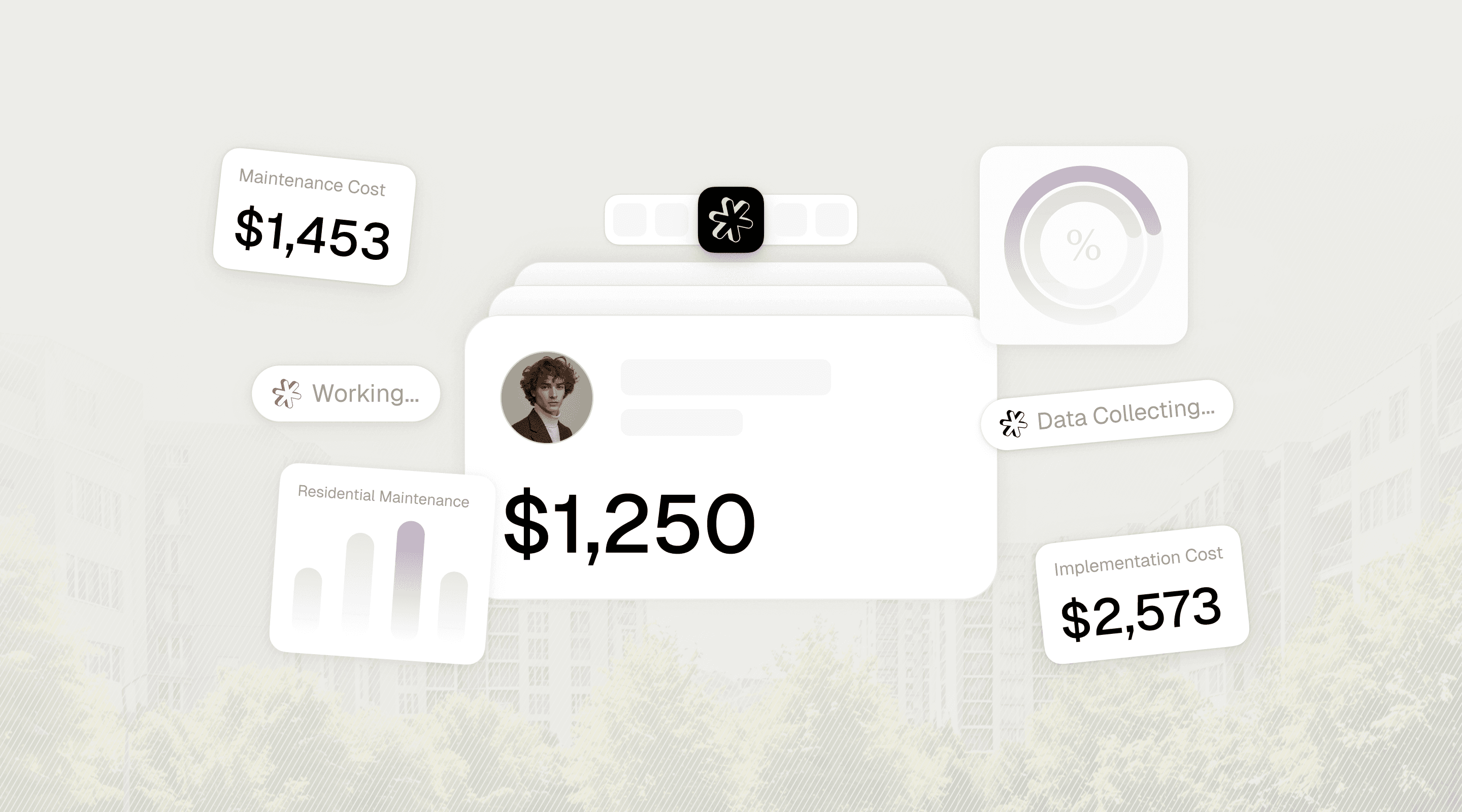
Property management technology total cost of ownership includes every new cost required to launch and maintain the chosen workflow. The subscription is only one part of it. If AI sits on top of the PMS and connects to calendars, inboxes, contractor tools or reporting systems, include the cost of making those connections work reliably too.
Include the work needed to connect systems, configure the task, train staff, test the process, manage it in production and keep it safe when systems or operating requirements change.
Exclude historic sunk cost from a forward-looking decision unless Finance also wants a separate retrospective view. Show the first-year cash burden and the longer multi-year cost separately. This prevents a low monthly subscription from hiding a costly launch.
Cost group | Include |
|---|---|
Set-up | Implementation, configuration, integration and internal project time |
Adoption | Training, change support and test time |
Running cost | Subscription, usage, support and workflow governance |
Change cost | New markets, system changes, extra channels and exit support |
One Off and Recurring Costs
This separation is central to property management technology total cost of ownership because first-year implementation effort can look very different from the ongoing cost of running the workflow at scale.
Show one-off set-up costs and recurring costs on separate lines. This gives property teams a clearer property management technology total cost of ownership view before they commit to wider rollout. You may spread set-up costs across a multi-year view, but the model should still show the full first-year cash requirement.
A pilot can appear inexpensive when the calculation leaves out the work required to make it operational.
How Should Shared Costs Be Allocated?
Allocate each shared platform or integration cost once, using the same type of driver selected for shared benefits.
Do not allow every workflow to claim the full cost of the same platform. Record the allocation rule in the cost register so Finance can reproduce the calculation later.
Which Benefits Can Count Toward AI ROI?
A defensible property management automation ROI model groups benefits by the way they change money or operating capacity, not by the feature that produced them. Strict ROI may include verified labour cost reductions, removed external expenditure, rent protected or lower operating costs.
The wider AI ROI in property management view should also show whether the team can handle more volume, maintain service levels and scale the portfolio more efficiently.
Every benefit line should point to the source record Finance will use to accept it.
The useful question is not simply whether the tool helped. It is how that help changed cost or income for the chosen entity during the chosen period.
Rent Protection and Operating Savings
These are common inputs in property management automation ROI when the AI workflow improves lettings speed, follow-up or operational execution in a way that can be traced to a financial result.
Verified rent protection may count once when the avoidable void loss and accounting treatment are clear. Lower operating expenditure may count when invoices or ledger records show the change.
We break down the detailed void calculation in our guide to reducing void periods. In this model, treat void reduction as one benefit line rather than creating a second ROI method around the same gain.
How Should Supplier and Maintenance Savings Be Treated?
Count supplier or maintenance savings only when expenditure changes through an invoice, contract adjustment or avoided callout cost.
Faster repair resolution is useful evidence of service improvement. It is not a cash saving by itself. Do not turn a shorter task time into a financial benefit unless a clear cost line has changed.
When Do Saved Hours Become Financial Value?
Saved time creates operational capacity first. It becomes a financial benefit only when it leads to a documented payroll reduction, less temporary cover, lower external spend or approved hiring avoidance.
This distinction keeps your property management AI ROI case credible with Finance while still showing the wider team what AI is giving back: more capacity, faster response and room to scale.
Multiplying saved hours by a salary rate can help show the value of released capacity. It does not prove that the business has saved cash. The team may use the time to improve service, clear a backlog or manage more homes.
Those outcomes are worth reporting, but they belong in the capacity view until a financial action takes place.
When Can Released Capacity Count as a Cash Saving?
For property management automation ROI, released capacity is often one of the first benefits a team sees. Keep it operational until it changes a real staffing, supplier or service cost.
Released capacity can enter strict realised ROI after a real cost action occurs. This may be a payroll reduction, lower agency spend or removal of an external service.
Record the effective date, owner, cost line and supporting evidence. Until then, keep the saved hours in the capacity scorecard.
How Should Approved Hiring Avoidance Be Reported?
An avoided hire can enter inclusive forecast ROI when an approved staffing plan changes. Record the role, fully loaded cost, timing and budget owner.
Do not use the figure to claim that the system has replaced a fixed number of people. The value depends on the staffing decision that the organisation actually makes.
How Can Property Teams Avoid Double Counting AI Benefits?
Use a one-benefit-once rule. One operational improvement may affect conversion, voids, occupancy, NOI and asset value, but the underlying attributable cash gain should appear only once in AI ROI in property management. This keeps property management AI ROI credible when the same workflow influences several portfolio metrics.
Show its relationship to other measures through reconciliation, not by adding more headline value.
Create a benefits register before calculating the total. Give each benefit a unique ID, source workflow, owner, source record, calculation method and accounting treatment. This exposes overlap before it reaches a board paper.
Should Void Reduction, NOI, and Asset Value All Enter ROI?
No. When rent protected through a shorter void is the underlying cash gain, count that rent once.
You may show how the same gain affects NOI. Asset Management may also want a separate asset value sensitivity. Neither should be added to the AI ROI total as another benefit.
We explain the link between operational automation and NOI in how property management automation improves NOI. The outcomes there relate to a stated deployment, so use them as context, not as default assumptions for your own model.
How Should Shared Benefits Be Reconciled Across Workflows?
Assign every benefit to one workflow ID and one owner. If a lettings improvement also supports an asset report, the financial benefit still belongs in one place.
Reconcile shared benefits before calculating a portfolio total. One cash gain should have one line in the benefits register.
How Can You Prove That AI Caused the Improvement?
Attribution requires a reliable baseline and a fair comparison. A pilot result may also be influenced by market demand, pricing, staffing, policy changes or a different mix of homes. Good attribution is essential if AI ROI in property management is going to support a decision to roll the workflow across more sites or units.
Use the strongest practical comparison available and record its limitations. A conservative explanation of what changed is more useful than a claim of certainty that the evidence cannot support.
The goal is not to run a perfect academic study. It is to create a clear decision record that shows what changed, what else changed and why the team believes the AI-enabled workflow contributed to the result.
Which Counterfactual Is Strong Enough for an Investment Decision?
Where practical, use a matched asset group, a comparable period, a phased rollout or a representative pilot. Compare similar units and market conditions.
Record adoption, workflow volume and any remaining set-up cost. If the comparison group improves at the same time, reduce the share of the result attributed to AI.
How Should Pilot Results Be Annualised?
Annualise pilot results only after adjusting for seasonality, adoption, volume and costs that have not yet been incurred.
Show conservative, expected and downside cases. A strong result from one month may help shape the next question, but it does not prove a full-year portfolio return.
What Does a Defensible AI ROI Example Look Like?
Here is a simple fictional example you can adapt to your own portfolio. We are not presenting these numbers as Lette pricing, a Lette customer result or a performance promise. The point is to show you how to use an AI ROI calculator while keeping cash return, forecast value and operational capacity in the right buckets.
Use the structure, then replace every number with evidence from your own PMS, workflow data, contracts and Finance records.
Which Inputs Should a Conservative AI ROI Example Include?
Assume your team runs an approved out-of-hours leasing workflow for twelve months. Finance defines the entity, reporting period and currency, while leasing and operations provide the workflow evidence. Every number has a named route back to a source record.
Line | Fictional input | Evidence status | ROI view |
|---|---|---|---|
Subscription and support | £30,000 | Contract | Strict cost |
Set-up, training and internal time | £30,000 | Approved project cost | Strict cost |
Cancelled temporary cover | £30,000 | Payroll record | Strict benefit |
Verified rent protection | £36,000 | PMS and Finance record | Strict benefit |
Approved avoided hire | £45,000 | Staffing plan | Inclusive forecast only |
Time returned to team | 1,200 hours | Workflow record | Capacity scorecard |
Strict ROI, Inclusive ROI, and Payback
The same example can be entered into an AI ROI calculator and then tested against the AI payback period to show both percentage return and how quickly the initial cost is recovered.
Total strict cost is £60,000. Strict verified benefit is £66,000. Net strict benefit is therefore £6,000, which produces a strict ROI of 10 per cent.
When the £45,000 approved avoided hire is added to the inclusive forecast, total benefit rises to £111,000. Inclusive forecast ROI is then 85 per cent.
Both figures are useful because they answer different questions. Strict ROI shows the first-year return that Finance can verify now. Inclusive forecast ROI shows the expected case if the approved hire does not happen.
The 1,200 returned hours remain in the capacity scorecard unless another cost action turns them into a financial saving.
Investment Tests Beyond ROI
ROI is one part of the scale decision. The AI payback period shows how long it takes to recover the cash cost. Net present value helps compare costs and benefits received across several years. Sensitivity analysis shows how AI ROI in property management changes when adoption, workflow volume, timing or cost moves.
Use the same baseline and benefits register for every test.
How Should Payback and NPV Be Used Together?
The AI payback period is especially useful for property teams comparing pilots because it answers a simple operational investment question: how long before the workflow earns back what it cost to launch?
Use payback when Finance needs to know how quickly the investment returns its cash cost. Use NPV when costs and benefits arrive over more than one year.
Apply a discount rate approved by Finance. Do not insert a generic market rate into a board model without agreement.
Which Assumptions Should Property Teams Test in a Sensitivity Analysis?
Sensitivity testing makes the AI payback period and ROI more useful when a portfolio is growing, because workflow volumes, staffing needs and adoption rarely stay fixed.
Test adoption, workflow volume, timing of benefits, rent protection, hiring avoidance, cost allocation and ongoing support.
Show a conservative case, an expected case and a downside case. The downside case often provides the clearest signal about whether the pilot should remain limited.
How Should Property Teams Use AI ROI Results?
Use the result as a decision record, not a vanity metric. The point of AI ROI in property management is to decide whether you should scale the workflow, revise it or stop it, and how much more work your team can realistically absorb as the portfolio grows.
Your review pack should show the workflow, baseline, cost register, benefits register, comparison method, assumptions, approvals and source records. Operations owns whether the work is actually getting done. Finance owns the accounting treatment.
Asset, leasing, resident and maintenance leaders should be able to see what the result means for their part of the portfolio.
When Should You Scale, Revise, or Stop?
Scale when the workflow performs as intended, your teams are actually using it, controls hold and the agreed economic case is met.
At that point, AI ROI in property management is no longer just a pilot metric. It becomes evidence that you can move more work through the operation without growing cost and admin at the same rate.
Revise when the workflow works but the baseline, cost allocation or another assumption needs correction.
Stop when the workflow cannot meet the approved case or cannot operate with safe controls.
How Do We Help You Measure AI ROI With Lette?
We built Lette for property teams that want to move faster without ripping out the PMS and systems they already rely on. Lette is our Property Management & Leasing Automation Platform, built to work as the system of action on top of your existing stack while your PMS remains the system of record.
Across leasing, we automate repeatable work from lead qualification through viewings and documentation. Across resident operations, we help teams run move-ins, move-outs, renewals, reminders, rent follow-up and resident support.
In maintenance, we automate intake, triage, assignment, contractor coordination and status updates.
With Lette Intelligence and Reporting, we give teams real-time visibility across leasing, resident operations and maintenance so they can see what is moving, what is slowing down and where the team needs to act.
That is where AI ROI in property management becomes practical. You can measure workflow volume, completion, response, capacity and operational outcomes in the layer doing the work, then verify realised financial results against your PMS, payroll, contracts, Finance systems and general ledger. We do not ask you to replace your core stack. We help you get more work done through it.
If you are evaluating Lette, we want you to measure us this way. Do not judge the platform by a demo alone. Pick one workflow, agree the baseline, run it against your real operation and measure what changes.
What Are the Most Common Questions About AI ROI in Property Management?
Use the questions below to pressure-test your AI ROI calculator or business case without mixing early assumptions with realised results. They also make AI ROI in property management easier to compare across pilots, teams and workflows.
What Is the ROI?
AI ROI in property management depends on one defined workflow, its full incremental cost, its attributable benefits and the strength of the supporting evidence. A useful property management AI ROI answer should also show what happened to team capacity and service quality, even when those gains are not yet cash.
Report strict realised ROI, inclusive forecast ROI and released capacity as separate answers. There is no honest universal ROI percentage that applies to every property portfolio.
How Does AI Cost Compare With the Cost of Three People’s Salaries?
Compare the workflow cost with a real, approved staffing plan and the fully loaded employment cost of the relevant roles.
Do not assume that time returned to a team means the system replaces three jobs. A staffing benefit belongs in strict ROI only after payroll changes. It may belong in forecast ROI when an approved hire is removed from the plan.
Are There Setup Fees, Integration Fees, and Onboarding Fees?
Include every incremental first-year cost required to make the workflow live. This may cover subscription, set-up, integration, configuration, training, internal time and support. Use property management technology total cost of ownership rather than subscription price alone when comparing vendors or deciding whether to scale.
Show launch costs and recurring costs separately so your property team and Finance can see both the first-year cash burden and the ongoing run rate.
Can We Start With One Module and Expand?
Yes. Ring-fence one workflow, its relevant costs and its expected benefits first. This is often the cleanest way to establish property management automation ROI before expanding AI across more of the PMS-connected operating stack.
Keep platform-wide gains and expansion assumptions outside the pilot calculation until the team has tested them. This creates a cleaner basis for the next decision about scale and makes AI ROI in property management easier to compare as new workflows are added.
Conclusion
AI ROI in property management becomes useful when it answers the growth question you actually care about: can AI help your team move faster, manage more work and maintain service as the portfolio scales?
Choose one workflow. Agree the baseline, entity boundary, cost register, benefit rules and pass test. Keep realised cash, forecast savings and released capacity in separate views. Then scale only when the evidence says the workflow is working.
That is exactly how we want teams to evaluate Lette. If you want to see what this looks like on top of your PMS, bring us one real workflow and your current process. We will map what can be automated across leasing, resident operations, maintenance or reporting, then give you a clear basis for measuring the result. Book a focused workflow review with our team.
If you are putting AI on top of your PMS to move faster, handle more work and scale your portfolio, one question matters: is the AI creating measurable value?
To calculate AI ROI in property management, compare the measurable benefit from one AI-enabled workflow with the full cost of launching and running it. Keep cash return, forecast savings, released team capacity and service improvements separate so you can see what is financially realised and what is operationally valuable.
We see the same goal across ambitious property teams: grow the portfolio without growing admin at the same pace.
That is why we built Lette, the Property Management & Leasing Automation Platform that sits on top of your existing PMS and property stack. Your PMS remains the system of record.
We automate the repetitive work around it across leasing, resident operations, maintenance, and reporting so your team can move faster and scale without replacing the systems you already trust.
This guide shows you how to measure AI ROI in property management without turning it into a Finance-only exercise.
You will learn how to build a baseline, calculate costs and benefits, use an AI ROI calculator, measure property management automation ROI, estimate the AI payback period, and understand property management technology total cost of ownership. Finance verifies realised financial value, but the evidence starts with the teams doing the work: operations, asset management, leasing, resident operations and maintenance.
AI ROI in Property Management
AI ROI in property management is the return you create when an AI-enabled workflow improves how your team runs the operation. That return may come from lower cost, protected income, avoided future cost or the ability to handle more work with the same team.
Measure it at workflow level, such as leasing, resident operations, maintenance or reporting, rather than confusing it with the investment return from owning the properties themselves.
Not every valuable improvement becomes cash on day one.
You may clear queues faster, handle more resident conversations, keep your PMS cleaner or add units without adding headcount at the same rate. Those gains belong in the AI ROI in property management case.
They should enter headline financial ROI only when there is a clear financial mechanism that Finance can verify.
Measure | What it asks | Keep it separate from |
|---|---|---|
AI ROI | Did the workflow return more cash than it cost | Property return |
NOI | Did property income less operating cost change | Technology ROI |
Asset value | How might future income affect value | The same underlying cash gain |
Released capacity | What work can the team now do | Payroll saving unless a cost action occurs |
ROI, NOI, and Asset Value
AI can affect NOI when it creates a genuine operating change, such as lower expenditure or rent protected by avoiding part of a void period. That does not make AI ROI, NOI and asset value the same measure.
Count the underlying cash gain once in the AI ROI calculation. You may then show how that gain affects NOI, but treat it as a link to the same benefit rather than another benefit line. Any asset value sensitivity should also remain separate.
Whose Return Are You Calculating?
Before you add a single figure, decide who is paying for the technology, who receives the benefit and who owns the workflow. This keeps AI ROI in property management useful to the teams running the operation as well as the people approving the investment.
The same workflow can create different returns for an owner, an operating company and a third-party manager.
For example, your operating company may pay for the platform and reduce temporary staffing costs. The owner may benefit from rent protected through a shorter void. A management company may lower its cost to serve or improve contract margin. Calculate the return around the costs and benefits that actually sit with the entity making the decision.
Owner Operators and Third Party Managers
Owner operators can review rent, property operating expenses and the cost of their own operating company. Third-party managers should focus on contract margin, service levels, cost to serve and the cost of winning or onboarding new instructions.
Do not include an owner benefit in the manager's ROI unless the management contract passes that benefit to the manager.
How Should Shared Costs and Benefits Be Allocated?
Assign every shared cost and benefit to one owner before combining the figures. Use an allocation driver that is simple, consistent and easy to test. Suitable drivers may include active units, workflow volume, legal entity or share of service time.
Keep the chosen driver unchanged throughout the reporting period.
Shared item | Possible driver | Named owner |
|---|---|---|
Platform cost | Active units | Operating company |
Integration cost | Workflow volume | Workflow owner |
Rent protection | Asset and legal entity | Owner entity |
Service cost saving | Cases handled | Management company |
Three AI ROI Views Property Teams Should Keep Separate
Keep three views side by side. Strict realised ROI shows cash or accrual value that Finance can verify. Inclusive forecast ROI adds approved future savings. The operational capacity view shows the time, service, throughput and scaling gains your team is getting back without pretending they are already cash. This is what makes AI ROI in property management useful for operating decisions, not just budget reviews.
The most useful figure is not always the largest one. It is the figure that answers the decision being made and clearly shows the evidence behind it.
Outcome | Strict realised ROI | Inclusive forecast ROI | Capacity scorecard |
|---|---|---|---|
Payroll reduction | Yes when booked | Yes when approved and timed | Show team effect |
Cancelled supplier cost | Yes when spend changes | Yes if contract exit is agreed | Show service effect |
Avoided hire | No until cost action | Yes with approved plan | Show added workload |
Hours returned | No | No | Yes |
Resident service gain | No | No unless cash link is known | Yes |
Strict Realised Financial ROI
For a property management AI ROI model, this is the most conservative view. Use it when you need to show leadership what value has already moved from faster work or better operations into a verifiable cost or income line.
Strict realised ROI includes only attributable benefits that Finance can verify against the full incremental cost of the workflow. Examples include a removed external cost, a booked payroll reduction or verified rent protection.
Use one reporting period, one currency, one entity boundary and one accounting basis throughout the calculation.
When Can Forecast Cost Avoidance Be Included?
Include an avoided hire or planned supplier reduction only in the inclusive forecast view. Record the approved role or contract, loaded cost, expected start date, budget owner and the reason the AI workflow makes the saving possible.
Move the benefit into strict realised ROI only after the staffing or supplier cost has actually changed.
Which Benefits Should Stay Outside Headline ROI?
Keep released capacity, faster service, resident experience and risk reduction in a supporting scorecard until there is a documented cash link.
These outcomes may be central to the value of the workflow. They do not become cash simply because someone multiplies saved hours by an hourly salary rate.
The AI ROI Formula
Use one strict formula for the headline result. Define the workflow, entity, period, currency and accounting basis first. Then compare verified attributable benefits with the total incremental cost inside that same boundary.
An ROI calculator can handle the arithmetic. The real work is making sure the inputs reflect what actually changed in your operation.
Do not combine forecast, observed and realised values in one ROI percentage.
Strict AI ROI percentage equals finance-verified attributable benefits minus total incremental costs, divided by total incremental costs, multiplied by 100.
Input | Plain meaning |
|---|---|
Attributable benefits | Cash or accrual gain Finance can trace to the workflow |
Total incremental costs | All new cost to put and keep the workflow live |
Net benefit | Attributable benefits less total incremental costs |
ROI percentage | Net benefit divided by total incremental costs, multiplied by 100 |
The Strict ROI Formula
An AI ROI calculator should use the same boundary for costs and benefits. Do not enter portfolio-wide benefits against the cost of a single workflow or mix annualised estimates with realised values.
For a finance-verified headline calculation, use:
Strict AI ROI percentage equals finance-verified attributable benefits less total incremental costs, divided by total incremental costs, multiplied by 100.
For example, if verified benefits are £90,000 and total incremental costs are £60,000, the net benefit is £30,000. Strict ROI is therefore 50 per cent.
The calculation is straightforward. The quality of the result depends on the evidence supporting the £90,000 benefit.
How Should Forecast, Observed, and Realised Results Be Labelled?
Label every result according to its evidence status. A forecast is an assumption. An approved forecast has a named budget action behind it. An observed result is what the pilot produced. A finance-verified result has been checked by Finance. A realised result has reached the accounts. An annualised pilot run rate should not be presented as a realised portfolio result.
What Baseline Data Do Property Teams Need for a Defensible AI ROI?
Start with the smallest useful unit: one workflow, asset group or legal entity. Before AI changes the process, record the current workload, delay, cost and outcome. If you are using AI on top of your PMS, this baseline is what turns AI ROI in property management from a vague productivity claim into a measurable operating result.
A clean baseline makes it easier to show what changed, what stayed the same and which result can reasonably be attributed to the workflow.
We cover detailed event definitions and reporting practice in our property management data and KPI guide.
Which Inputs Should Come From Operations, Finance, and the PMS?
Your operations teams should own workflow volume, case status and service steps. Your PMS should remain the system of record for source events and core case data. Finance, payroll and contract records should support labour costs, supplier spend and realised cash outcomes.
Put the source of truth next to every number. If the figure cannot be traced, do not build a scaling decision around it.
Input | Source of truth | Owner |
|---|---|---|
Lead or repair volume | PMS and workflow log | Operations |
Case state and delay | PMS | Workflow owner |
Payroll cost | Payroll and Finance | Finance |
Supplier spend | Contract and invoice | Finance |
Rent protected | PMS and Finance record | Owner entity |
Seasonality and Portfolio Mix
Compare similar assets, unit types, markets and demand periods wherever possible. Do not annualise a strong lease-up month, a short launch period or one unusual site without adjusting for the conditions that made it different.
Record the limits of the comparison so the next reviewer can see where the result may be less reliable.
Which Costs Belong in AI Total Cost of Ownership?
Property management technology total cost of ownership includes every new cost required to launch and maintain the chosen workflow. The subscription is only one part of it. If AI sits on top of the PMS and connects to calendars, inboxes, contractor tools or reporting systems, include the cost of making those connections work reliably too.
Include the work needed to connect systems, configure the task, train staff, test the process, manage it in production and keep it safe when systems or operating requirements change.
Exclude historic sunk cost from a forward-looking decision unless Finance also wants a separate retrospective view. Show the first-year cash burden and the longer multi-year cost separately. This prevents a low monthly subscription from hiding a costly launch.
Cost group | Include |
|---|---|
Set-up | Implementation, configuration, integration and internal project time |
Adoption | Training, change support and test time |
Running cost | Subscription, usage, support and workflow governance |
Change cost | New markets, system changes, extra channels and exit support |
One Off and Recurring Costs
This separation is central to property management technology total cost of ownership because first-year implementation effort can look very different from the ongoing cost of running the workflow at scale.
Show one-off set-up costs and recurring costs on separate lines. This gives property teams a clearer property management technology total cost of ownership view before they commit to wider rollout. You may spread set-up costs across a multi-year view, but the model should still show the full first-year cash requirement.
A pilot can appear inexpensive when the calculation leaves out the work required to make it operational.
How Should Shared Costs Be Allocated?
Allocate each shared platform or integration cost once, using the same type of driver selected for shared benefits.
Do not allow every workflow to claim the full cost of the same platform. Record the allocation rule in the cost register so Finance can reproduce the calculation later.
Which Benefits Can Count Toward AI ROI?
A defensible property management automation ROI model groups benefits by the way they change money or operating capacity, not by the feature that produced them. Strict ROI may include verified labour cost reductions, removed external expenditure, rent protected or lower operating costs.
The wider AI ROI in property management view should also show whether the team can handle more volume, maintain service levels and scale the portfolio more efficiently.
Every benefit line should point to the source record Finance will use to accept it.
The useful question is not simply whether the tool helped. It is how that help changed cost or income for the chosen entity during the chosen period.
Rent Protection and Operating Savings
These are common inputs in property management automation ROI when the AI workflow improves lettings speed, follow-up or operational execution in a way that can be traced to a financial result.
Verified rent protection may count once when the avoidable void loss and accounting treatment are clear. Lower operating expenditure may count when invoices or ledger records show the change.
We break down the detailed void calculation in our guide to reducing void periods. In this model, treat void reduction as one benefit line rather than creating a second ROI method around the same gain.
How Should Supplier and Maintenance Savings Be Treated?
Count supplier or maintenance savings only when expenditure changes through an invoice, contract adjustment or avoided callout cost.
Faster repair resolution is useful evidence of service improvement. It is not a cash saving by itself. Do not turn a shorter task time into a financial benefit unless a clear cost line has changed.
When Do Saved Hours Become Financial Value?
Saved time creates operational capacity first. It becomes a financial benefit only when it leads to a documented payroll reduction, less temporary cover, lower external spend or approved hiring avoidance.
This distinction keeps your property management AI ROI case credible with Finance while still showing the wider team what AI is giving back: more capacity, faster response and room to scale.
Multiplying saved hours by a salary rate can help show the value of released capacity. It does not prove that the business has saved cash. The team may use the time to improve service, clear a backlog or manage more homes.
Those outcomes are worth reporting, but they belong in the capacity view until a financial action takes place.
When Can Released Capacity Count as a Cash Saving?
For property management automation ROI, released capacity is often one of the first benefits a team sees. Keep it operational until it changes a real staffing, supplier or service cost.
Released capacity can enter strict realised ROI after a real cost action occurs. This may be a payroll reduction, lower agency spend or removal of an external service.
Record the effective date, owner, cost line and supporting evidence. Until then, keep the saved hours in the capacity scorecard.
How Should Approved Hiring Avoidance Be Reported?
An avoided hire can enter inclusive forecast ROI when an approved staffing plan changes. Record the role, fully loaded cost, timing and budget owner.
Do not use the figure to claim that the system has replaced a fixed number of people. The value depends on the staffing decision that the organisation actually makes.
How Can Property Teams Avoid Double Counting AI Benefits?
Use a one-benefit-once rule. One operational improvement may affect conversion, voids, occupancy, NOI and asset value, but the underlying attributable cash gain should appear only once in AI ROI in property management. This keeps property management AI ROI credible when the same workflow influences several portfolio metrics.
Show its relationship to other measures through reconciliation, not by adding more headline value.
Create a benefits register before calculating the total. Give each benefit a unique ID, source workflow, owner, source record, calculation method and accounting treatment. This exposes overlap before it reaches a board paper.
Should Void Reduction, NOI, and Asset Value All Enter ROI?
No. When rent protected through a shorter void is the underlying cash gain, count that rent once.
You may show how the same gain affects NOI. Asset Management may also want a separate asset value sensitivity. Neither should be added to the AI ROI total as another benefit.
We explain the link between operational automation and NOI in how property management automation improves NOI. The outcomes there relate to a stated deployment, so use them as context, not as default assumptions for your own model.
How Should Shared Benefits Be Reconciled Across Workflows?
Assign every benefit to one workflow ID and one owner. If a lettings improvement also supports an asset report, the financial benefit still belongs in one place.
Reconcile shared benefits before calculating a portfolio total. One cash gain should have one line in the benefits register.
How Can You Prove That AI Caused the Improvement?
Attribution requires a reliable baseline and a fair comparison. A pilot result may also be influenced by market demand, pricing, staffing, policy changes or a different mix of homes. Good attribution is essential if AI ROI in property management is going to support a decision to roll the workflow across more sites or units.
Use the strongest practical comparison available and record its limitations. A conservative explanation of what changed is more useful than a claim of certainty that the evidence cannot support.
The goal is not to run a perfect academic study. It is to create a clear decision record that shows what changed, what else changed and why the team believes the AI-enabled workflow contributed to the result.
Which Counterfactual Is Strong Enough for an Investment Decision?
Where practical, use a matched asset group, a comparable period, a phased rollout or a representative pilot. Compare similar units and market conditions.
Record adoption, workflow volume and any remaining set-up cost. If the comparison group improves at the same time, reduce the share of the result attributed to AI.
How Should Pilot Results Be Annualised?
Annualise pilot results only after adjusting for seasonality, adoption, volume and costs that have not yet been incurred.
Show conservative, expected and downside cases. A strong result from one month may help shape the next question, but it does not prove a full-year portfolio return.
What Does a Defensible AI ROI Example Look Like?
Here is a simple fictional example you can adapt to your own portfolio. We are not presenting these numbers as Lette pricing, a Lette customer result or a performance promise. The point is to show you how to use an AI ROI calculator while keeping cash return, forecast value and operational capacity in the right buckets.
Use the structure, then replace every number with evidence from your own PMS, workflow data, contracts and Finance records.
Which Inputs Should a Conservative AI ROI Example Include?
Assume your team runs an approved out-of-hours leasing workflow for twelve months. Finance defines the entity, reporting period and currency, while leasing and operations provide the workflow evidence. Every number has a named route back to a source record.
Line | Fictional input | Evidence status | ROI view |
|---|---|---|---|
Subscription and support | £30,000 | Contract | Strict cost |
Set-up, training and internal time | £30,000 | Approved project cost | Strict cost |
Cancelled temporary cover | £30,000 | Payroll record | Strict benefit |
Verified rent protection | £36,000 | PMS and Finance record | Strict benefit |
Approved avoided hire | £45,000 | Staffing plan | Inclusive forecast only |
Time returned to team | 1,200 hours | Workflow record | Capacity scorecard |
Strict ROI, Inclusive ROI, and Payback
The same example can be entered into an AI ROI calculator and then tested against the AI payback period to show both percentage return and how quickly the initial cost is recovered.
Total strict cost is £60,000. Strict verified benefit is £66,000. Net strict benefit is therefore £6,000, which produces a strict ROI of 10 per cent.
When the £45,000 approved avoided hire is added to the inclusive forecast, total benefit rises to £111,000. Inclusive forecast ROI is then 85 per cent.
Both figures are useful because they answer different questions. Strict ROI shows the first-year return that Finance can verify now. Inclusive forecast ROI shows the expected case if the approved hire does not happen.
The 1,200 returned hours remain in the capacity scorecard unless another cost action turns them into a financial saving.
Investment Tests Beyond ROI
ROI is one part of the scale decision. The AI payback period shows how long it takes to recover the cash cost. Net present value helps compare costs and benefits received across several years. Sensitivity analysis shows how AI ROI in property management changes when adoption, workflow volume, timing or cost moves.
Use the same baseline and benefits register for every test.
How Should Payback and NPV Be Used Together?
The AI payback period is especially useful for property teams comparing pilots because it answers a simple operational investment question: how long before the workflow earns back what it cost to launch?
Use payback when Finance needs to know how quickly the investment returns its cash cost. Use NPV when costs and benefits arrive over more than one year.
Apply a discount rate approved by Finance. Do not insert a generic market rate into a board model without agreement.
Which Assumptions Should Property Teams Test in a Sensitivity Analysis?
Sensitivity testing makes the AI payback period and ROI more useful when a portfolio is growing, because workflow volumes, staffing needs and adoption rarely stay fixed.
Test adoption, workflow volume, timing of benefits, rent protection, hiring avoidance, cost allocation and ongoing support.
Show a conservative case, an expected case and a downside case. The downside case often provides the clearest signal about whether the pilot should remain limited.
How Should Property Teams Use AI ROI Results?
Use the result as a decision record, not a vanity metric. The point of AI ROI in property management is to decide whether you should scale the workflow, revise it or stop it, and how much more work your team can realistically absorb as the portfolio grows.
Your review pack should show the workflow, baseline, cost register, benefits register, comparison method, assumptions, approvals and source records. Operations owns whether the work is actually getting done. Finance owns the accounting treatment.
Asset, leasing, resident and maintenance leaders should be able to see what the result means for their part of the portfolio.
When Should You Scale, Revise, or Stop?
Scale when the workflow performs as intended, your teams are actually using it, controls hold and the agreed economic case is met.
At that point, AI ROI in property management is no longer just a pilot metric. It becomes evidence that you can move more work through the operation without growing cost and admin at the same rate.
Revise when the workflow works but the baseline, cost allocation or another assumption needs correction.
Stop when the workflow cannot meet the approved case or cannot operate with safe controls.
How Do We Help You Measure AI ROI With Lette?
We built Lette for property teams that want to move faster without ripping out the PMS and systems they already rely on. Lette is our Property Management & Leasing Automation Platform, built to work as the system of action on top of your existing stack while your PMS remains the system of record.
Across leasing, we automate repeatable work from lead qualification through viewings and documentation. Across resident operations, we help teams run move-ins, move-outs, renewals, reminders, rent follow-up and resident support.
In maintenance, we automate intake, triage, assignment, contractor coordination and status updates.
With Lette Intelligence and Reporting, we give teams real-time visibility across leasing, resident operations and maintenance so they can see what is moving, what is slowing down and where the team needs to act.
That is where AI ROI in property management becomes practical. You can measure workflow volume, completion, response, capacity and operational outcomes in the layer doing the work, then verify realised financial results against your PMS, payroll, contracts, Finance systems and general ledger. We do not ask you to replace your core stack. We help you get more work done through it.
If you are evaluating Lette, we want you to measure us this way. Do not judge the platform by a demo alone. Pick one workflow, agree the baseline, run it against your real operation and measure what changes.
What Are the Most Common Questions About AI ROI in Property Management?
Use the questions below to pressure-test your AI ROI calculator or business case without mixing early assumptions with realised results. They also make AI ROI in property management easier to compare across pilots, teams and workflows.
What Is the ROI?
AI ROI in property management depends on one defined workflow, its full incremental cost, its attributable benefits and the strength of the supporting evidence. A useful property management AI ROI answer should also show what happened to team capacity and service quality, even when those gains are not yet cash.
Report strict realised ROI, inclusive forecast ROI and released capacity as separate answers. There is no honest universal ROI percentage that applies to every property portfolio.
How Does AI Cost Compare With the Cost of Three People’s Salaries?
Compare the workflow cost with a real, approved staffing plan and the fully loaded employment cost of the relevant roles.
Do not assume that time returned to a team means the system replaces three jobs. A staffing benefit belongs in strict ROI only after payroll changes. It may belong in forecast ROI when an approved hire is removed from the plan.
Are There Setup Fees, Integration Fees, and Onboarding Fees?
Include every incremental first-year cost required to make the workflow live. This may cover subscription, set-up, integration, configuration, training, internal time and support. Use property management technology total cost of ownership rather than subscription price alone when comparing vendors or deciding whether to scale.
Show launch costs and recurring costs separately so your property team and Finance can see both the first-year cash burden and the ongoing run rate.
Can We Start With One Module and Expand?
Yes. Ring-fence one workflow, its relevant costs and its expected benefits first. This is often the cleanest way to establish property management automation ROI before expanding AI across more of the PMS-connected operating stack.
Keep platform-wide gains and expansion assumptions outside the pilot calculation until the team has tested them. This creates a cleaner basis for the next decision about scale and makes AI ROI in property management easier to compare as new workflows are added.
Conclusion
AI ROI in property management becomes useful when it answers the growth question you actually care about: can AI help your team move faster, manage more work and maintain service as the portfolio scales?
Choose one workflow. Agree the baseline, entity boundary, cost register, benefit rules and pass test. Keep realised cash, forecast savings and released capacity in separate views. Then scale only when the evidence says the workflow is working.
That is exactly how we want teams to evaluate Lette. If you want to see what this looks like on top of your PMS, bring us one real workflow and your current process. We will map what can be automated across leasing, resident operations, maintenance or reporting, then give you a clear basis for measuring the result. Book a focused workflow review with our team.

Ready to simplify your property operations?
See how Lette helps leasing and residential teams automate daily work, respond faster, and scale with confidence.

167-169 Great Portland Street 5th Floor London W1W 5PF
33 Fitzwilliam Place, Dublin 2 Carroll Estates Mews DUBLIN 2 D02 A5W0 IRELAND
info@lette.ai

Ready to simplify your property operations?
See how Lette helps leasing and residential teams automate daily work, respond faster, and scale with confidence.
167-169 Great Portland Street 5th Floor London W1W 5PF
33 Fitzwilliam Place, Dublin 2 Carroll Estates Mews DUBLIN 2 D02 A5W0 IRELAND
info@lette.ai
Ready to simplify your property operations?
See how Lette helps leasing and residential teams automate daily work, respond faster, and scale with confidence.
167-169 Great Portland Street 5th Floor London W1W 5PF
33 Fitzwilliam Place, Dublin 2 Carroll Estates Mews DUBLIN 2 D02 A5W0 IRELAND
info@lette.ai
Ready to simplify your property operations?
See how Lette helps leasing and residential teams automate daily work, respond faster, and scale with confidence.
167-169 Great Portland Street 5th Floor London W1W 5PF
33 Fitzwilliam Place, Dublin 2 Carroll Estates Mews DUBLIN 2 D02 A5W0 IRELAND
info@lette.ai